
01
Interpret mission context
An onboard reasoning layer translates mission intent and changing conditions into a proposed course of action.
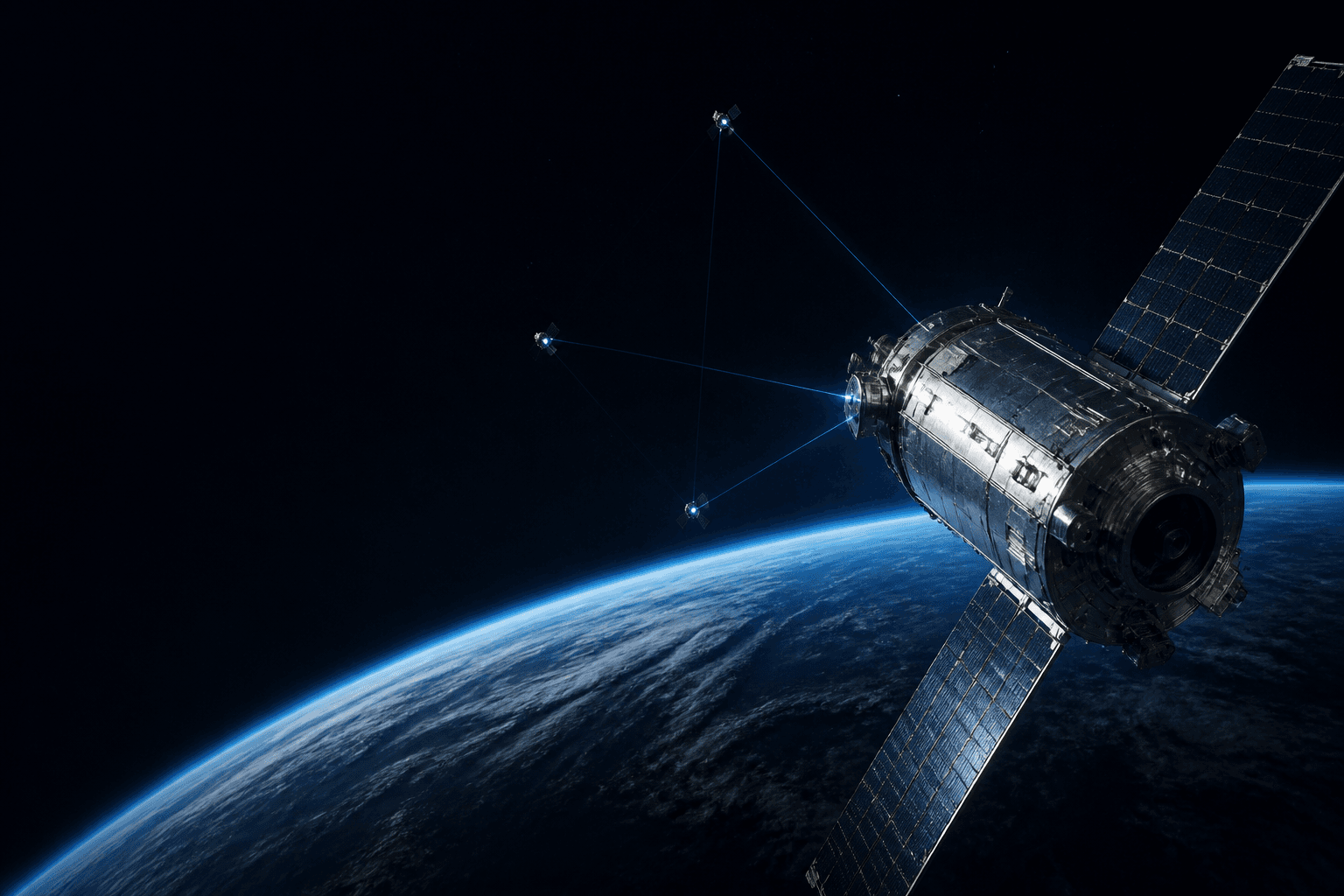
Ramstin enables spacecraft to interpret changing conditions and replan useful mission actions through communication gaps—while deterministic tools keep every decision inspectable, bounded, and safe to execute.
A controlled path to autonomy
Ramstin separates high-level mission reasoning from execution authority, giving operators a practical way to add adaptability without removing the safeguards already built into the spacecraft.
An onboard reasoning layer translates mission intent and changing conditions into a proposed course of action.
Deterministic tools check resources, constraints, permissions, and vehicle state before execution.
Only actions that satisfy the mission’s explicit rules are handed to existing flight software.
One auditable operating model
A two-layer architecture gives the reasoning model room to interpret the mission while deterministic controls remain the final authority.
Mission intent
Operators preserve authority over goals, permissions, and limits.
Reasoning layer
The model proposes useful actions when conditions change.
Execution boundary
Deterministic checks gate every action before flight execution.
Spacecraft systems
Validated actions pass into the vehicle’s established interfaces.
Built to complement flight systems
The hypothesis is simple: combine the adaptability of mission-level reasoning with a stricter execution boundary than an unconstrained model can provide.
Depend on contact windows and specialist-authored procedures for changing conditions.
Provides deterministic planning, but can require substantial modeling for new mission contexts.
Adds flexible interpretation at the mission layer while preserving an auditable, constraint-driven path to execution.